Friday, October 24, 2008

The Best Club


I literally just finished reading John Niven's, "John C. Calhoun and the Price of Union," but I want to read a famous essay about Calhoun by Richard Hoftstader before writing about the book and its subject. One thing that stood out for me, however, from both this book and Robert Remini's biography of Henry Clay is the relative ease with which prominent men like Calhoun and Clay moved in and out of the United States Senate.

Part of that, of course, is something that most of us have either forgotten or didn't know. The framers of the constitution set up the Senate so that Senators were not elected directly by the people, but indirectly by state legislatures. For example, when Abraham Lincoln lost the 1858 Illinois Senate race to Stephen Douglas, it was by a vote of the legislature, not the people of Illinos. With a limited number of people voting and the ability to have an election at any time to fill a vacancy prominent men could be and were elected without much difficulty. Calhoun's final election to the Senate came when an incumbent fulfilled a long time commitment simply to resign when Calhoun was ready to come back to the Senate.

Thinking about this reminded me of something else that we often lose track of today, the importance of an upper chamber. A chamber consisting of those who are only up for election every six years and can take a longer term view of problems and issues. Multiple examples of how such an arrangement has helped the country as well as a solid history of the Senate can be found in Robert Caro's "Master of the Senate. It is over a 1000 pages long, but in many places reads like a novel. I would recommend it to anyone regardless of their feelings about Johnson himself.

I think we saw another example of this recently in the case of the plan to bail out the banking industry. The first version of the plan started in the House and was defeated. In much of what I read the defeat was attributed to representatives unwillingness to vote a huge potential expenditure of tax payer money so close to election day. It was only when the second version of the plan started in the Senate that a modified package was passed. At least two-thirds of the Senators are not up for re-election and could take a longer term view. Regardless of whether the bail out of the banking industry is a good plan or a bad one, it is another example of why it makes sense to have a bicameral legislature. It enables the legislature to take both the short and the long term view.

Wednesday, October 22, 2008

Persuasion - Perhaps Starting To Get It


Earlier this week I finished "Persuasion" meaning that I am 5/6ths through the Austen canon. I need to say that I have been struggling with my thinking about Jane Austen as a writer. I read "Sense and Sensibility" some time ago and thought it was a good book although I felt that one part of the ending was somewhat contrived. "Pride and Prejudice," which I have read twice, I think is a great book. However as I got into "Mansfield Park," "Emma," and now "Persuasion," I have been having a lot of difficulty with why so many people think that Austen is a great writer.


I have tried to be very careful about expressing these doubts both because so many people have such high opinions of Austen and because of a concern that there might be some gender issues here. That is as a man reading books written by a woman about women probably in large measure for women, I may be missing something or somethings. At the same time I can say with complete honesty that I think Mary Ann Evans (George Eliot) is a great writer so perhaps it is also a matter of taste.


Some of the things that bother me about Austen's writing include what I think are too frequent use of what seems like divine intervention (deux ex machina) to resolve her plots, other endings that are never adequately explained and endings where it seems like everyone gets what they deserve (very different than life itself). I was thinking about this last night while driving home from a church meeting and remembered something that Elaine from Random Jottings wrote about "Jane Eyre." While reading Charlotte Bronte's classic as a teenager, Elaine was moved by Jane's standing up and demanding equality with Rochester - an example I think of what might be lost on a male reader.


This led me to think about Austen's heroines and what they have in common. I think it is fair to say that in the five books I have read so far all of them have a high degree of integrity. At least three of them turn down marriage proposals that would have been advantageous to them financially for which they are criticized by other family members. This, of course, is reminiscent of Austen herself who made a similar decision which for her (unlike her fictional heroines) had a real cost financial and otherwise. Given how limited women's options were in those days, it may be that Austen's consistent message that women should live their lives with integrity is something that resonates today even though circumstances are different.


I still need and want to think about this some more especially after I read "Northanger Abbey" and "The Jane Austen Book Club." I mention the latter book because I hope it will give me some insights as why Jane Austen is so popular. In the meantime if there are any "Janeites" out there reading this who would like to have some dialogue about this, I would greatly appreciate it.

Monday, October 20, 2008

Illusions of Clarity - Part II


While I am having illusions of clarity I may as well as go all the way. Another of my writing goals is to write a book about Shakespeare's history plays. A book that would be thoroughly researched, but not an academic book - a book that would try to explain why we should care about these plays. My thought is to write about the plays in the order Shakespeare wrote them so as to focus on how Shakespeare's thinking about kingship develops over time. I say kingship, but I really mean leadership because that is where I think the lasting importance of these plays lies - especially Henry V.


The other day Carol got a phone call that the adult school Shakespeare class that she had signed up for had been canceled. For some reason that gave me a thought - teach an adult school class on the history plays over a multi-year period. Teaching the class would motivate me to do the research that I would need to do anyway to write the book. Doing this over a multi-year period would allow it to be done gradually while I am working on other things.


The first step is to write a proposal and see if it is accepted. If not (and I think that highly probable) I could try other adult schools or perhaps a private high school where they do enrichment courses over the summer. It is at least worth a try. Of course all I have to do now is find the time to write the proposal. The main thing though is that there is a clarity that feels good - let's hope it stay that way.

Sunday, October 19, 2008

Illusions of Clarity

There are some parts of my life where moments of clarity are very fleeting. That is especially true of my nonfiction writing avocation - can't call it a career as it certainly isn't a money maker - more a question of limiting my cost. Part of my reason for retiring at 61 was to spend more time researching and writing.

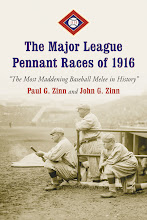
The challenge is that I have far more ideas about books than I will ever have time to write. To take the The Major League Pennant Races of 1916 as an example, research on that book began in earnest in the summer of 2003. The manuscript was finally sent to the publisher in February of 2008 and it will probably be published sometime the first quarter of 2009. Of course almost all of my work on that was while I was still working full time, but still researching and writing a book takes time, a lot of time.

I have had a lot of ideas about what comes next, but little clarity. However the other day everything seemed to fall into place. This is probably an illusion so I thought I better write about it while the moment lasts. At present I am working on two things, the New Jersey section of the pioneer project, which I have written about before, and the Civil War letters of William Lloyd.

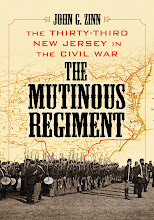
William Lloyd was a soldier in the 33rd New Jersey, the subject of my first book, "The Mutinous Regiment." One of the ironies of writing about the Civil War is that while Civil War soldiers wrote innumerable letters only a small percentage of them survive. By probably what is no more than chance, about 50 of Lloyd's letters survive and were a major source for my book.

Lloyd's letters are incredibly honest, he never hesitates to say what is on his mind. The best example is when his wife, Mary asks if she can go out with some men, Lloyd wrote back (this is almost a quote) "If you go out without anyone other than Briggs (brother-in-law) or Jeff (brother) I will disown you forever. I may as well as speak plain." Incredibly Lloyd then follows those harsh words with "Write again soon."

About two years ago a close friend introduced me to her God-son, who was then a junior in high school. I gave him some help on a Civil War research project and asked him if he would be interested in transcribing Lloyd's letters as part of editing them for publication. He was and did a great job before going off to college in September. So now I am at work on putting together a manuscript including writing background and introductory information on the letters as well as explanatory notes on the letters.

There is also more research to do on mysterious aspects of Lloyd's early life as well as his post war life. Lloyd lived until 1928 and his pension file is over 250 pages long! I hope to finish this sometime next year and then start looking for a publisher. I already have a title - I May as Well Speak Plain - The Civil War Letters of William Lloyd.

The pioneer project that I mentioned earlier has a deadline of April 1, 2009. This project is to consist of a compilations of histories of the most important teams in base ball's amateur era, roughly 1855 to 1870. I have already written first drafts for two Newark teams and one Paterson team and knew I had to do one about the Irvington Club. Looking at what else might be out there, I found the Champion Club of Jersey City plus the Resolutes of Elizabeth. Looking at all of this as well as some other clubs made me realize that there is enough material here to write a book. So after finishing the Lloyd letters and the pioneer project, I will work on expanding the pioneer project material into a book.

I had thought about such a book before, but it always seemed like it would become just a recitation of teams in different towns throughout New Jersey. As such it would be tedious to write and even more tedious to read. But now I think that there is enough in the way of themes there to write a book that will be interesting to read and will record the history of these long forgotten players and teams. As I say this may only be an illusion, no doubt in days or weeks I will have send thoughts, but for the moment I have clarity and it is a wonderful thing!

Friday, October 17, 2008

Books: To buy or not to buy?


Earlier this week, Simon from "Stuck in a Book" posed a sort of quiz about books and reading that Elaine at "Random Jottings" also wrote about. Looking at the quiz I was stopped short by the first question, what was the last book you bought? It's not that I can't remember, it was "Southern Storm: Sherman's March to the Sea" by Noah Trudeau. It is more that the question for me is incomplete - my answer is about the book that I most recently decided I wanted to own, not the most recent book I wanted to read. To me the question would have been more complete if it said something like, "what is the most recent book you bought or took out of the library?"

For as long as I can remember reading has been my favorite activity. However during my active working career, I was lucky if I could read somewhere between one to two dozen books a year. That was not, however, how many books I bought, I bought books pretty much without restraint. Among other things that led to unfortunate experiences like seeing books that I bought in hard cover coming out in paperback before I had read them. Or, and this is even worse, finding that I was no longer interested in the topic of a book I just had to have at the time of purchase.

This is something that I have struggled with for years - it has been a major stewardship issue for me - the place where I confront my own personal issues with material things. After all the issue isn't necessarily about owning, it is about reading. The thing that I have come to realize is that I can read just as many books (far more since retirement) for far less money and using far less space. It is due primarily to those wonderful institutions called libraries. Today I make extensive use of the Rutgers Library (free to Alumni) and countless other libraries in Verona and surrounding communities.

None of this is to suggest that I will never buy another book, but my approach is a lot different. The first and primary question is do I just want to read this book or do I want to own it as well. In the past year I have read a number of books of criticism of Shakespeare's history plays, some of them have been so helpful to my understanding that I know I will want to use them again and so I buy them. With other books there may be a reason why I want to own the book, but I am finding that that is more the exception than the norm. Besides costing less money, it also means not using as much space and ultimately having to dispose of those books in one way or another.

I think this is an example of a fundamental stewardship issue - good stewardship is about figuring out the most effective way to do what we want to or have to do. I want to read a lot of books, using libraries is a cost effective and efficient way of doing just that. Renting or even borrowing DVD's instead of going to the movies is another example of the same thing.

I am grateful to Simon and Elaine for raising these questions, in fact, the most recent books I borrowed from the library were "One Fine Day" and "Deerbrook," both of which were recommended by Elaine on her blog. I will probably buy "One Fine Day" because I think it will take multiple readings to really appreciate it. I have just started "Deerbrook" so it is too early to say. Other books that Elaine has recommended are not available at any library within 50 miles of here so this is case again where I may end up buying.

The final thing that I want to say is a word of praise for libraries. Untold amounts of knowledge and enjoyment is available to all of us in libraries - available at little or no cost. If nothing else the latter fact means that libraries offer tremendous opportunities to all regardless of how much money we have.

Tuesday, October 14, 2008

One Fine Day - Part II


As promised (threatened), I want to reflect for a few minutes on how Stephen and Laura work through their feelings about England in Mollie Panter-Downes (pictured here) "One Fine Day," given that their lives in this post war world will be very different. The focal point seems to be Barrow Down, the high ground still in a natural state where one can look down on the surrounding countryside. Perhaps somewhat ironically Stephen thinks about it on his way home from work not knowing that Laura is up there at that very moment without his knowing it.


Almost symbolically either being there or thinking about it helps them to think about England and what is going on their lives. Stephen starts to find some real clarity when he realizes that before the war they and their class were really puppets with their lives run by the servants who pulled the strings and now that no one was pulling the strings nothing works the way it had in the past. Perhaps this is a first step in moving towards how to live in this new world, but what seems even more significant is that they realize how important England is to them, how important it is that England won the war. And again, it is seeing and thinking about the land that is a major part of this.


Interestingly as an American of a completely different generation I can share some of these feelings. I have commented frequently about our trip to England earlier this year which was our third trip to England. Our first in 1976 was the traditional tourist guided tour of London and surrounding areas with one day around Stratford. The purpose of our second trip, almost 25 years later, in 2000 was to climb my family tree. We stayed in Tewksbury while visiting Horsely in Gloucestershire and Astley/Worcester in Worcestershire. Then we met my third cousin who graciously hosted us for a week in Audley in Staffordshire.


This trip was off the typical tourist path so we had to plan it all by ourselves and for almost two weeks we did not see or talk to another American. We learned and saw a lot about my English ancestors and the plan was to go back once I had gotten better organized on my research. The trip we made this year was for an entirely different reason - to see Shakespeare's entire history cycle at Stratford. While it certainly wasn't spur of the moment, it was fairly spontaneous ruling out any possibility of doing family history research.


We did, however, go a few days early leaving open the possibility of visiting my cousin in Audley plus some other distant relatives who I had met over the Internet. The idea was that on our first full day there, we would take the train from Stratford to Birmingham and then Stoke. For a while it seemed like the meeting with my relatives might not happen and I remember saying to Carol that if we couldn't do that I didn't want to make the trip since the only other reason to go was to do research and there wasn't enough time for that.


Fortunately we did work out the visit with my relatives which was wonderful. However, what I didn't expect in any way was how moved I was to be back in Audley. We had time both before and after our lunch and my cousin drove us around in her car plus we walked into the village looking for the site on the home of one of my earliest ancestors. My roots in Audley go back into the 1500's and I was surprised by the strong feelings I had about visiting there again and am very grateful that we got there.


Carol and I are planning another trip to England sometime in 2010. At present there are two goals, family history and visiting places related to our favorite authors, we especially want to visit Dartmoor, the site of "The Hound of the Baskervilles." On the family history side I want to do research as it is definitely time to write all this down in a form it can be passed on to future generations. But equally important I want to spend a few days in Nympsfield and Horsely in Gloucestershire as well as Audley - walking in the village and through the surrounding countryside, renewing connections that are hundreds of years old.


All of this helped me both understand and appreciate how Stephen and Laura come to a deeper understanding of what England means to them. I am very grateful to Elaine of Random Jottings for introducing me to this author. And the good news is that this was just the first of the authors she recommended - so many books so little time!

Monday, October 13, 2008

The Sun Sets on the Season


Yesterday on a pristine October afternoon the Eureka Base Ball Club of Newark (21st Century version) concluded its 2008 season with a loss to the Mountain Athletic Club of Fleischmann's, New York. Carol and I made the 2 plus hour ride up to Fleischmann's in Delaware County, in addition to the game we got a chance to see some spectacular autumn foliage.


This game was played under 1890's rules which is very similar to today's game, the major exception being that foul balls are not strikes. After seeing a few games played by these rules I understand why reformers wanted to change this rule - it is a tremendous advantage to the batter. Of all the forms of 19th century rules I have to say that I like the 1890's version (the overhand game) the least. I think the closer that the rules are to the modern game, the more it favors teams made up of predominantly younger players which is definitely not this year's version of the Eureka. The other thing is that if we are going to recreate an early version of the game it seems to make sense to do so in a way that is distinctly different from today.


One encouraging development is that there is interest in forming two new teams next year which would give us five vintage base ball teams in New Jersey. That would allow for more games in the state with less travel. Being retired I don't mind the travel that much, but it is tough on younger guys especially those with young children. There is to be a meeting on the subject in the near future and I hope we can make this happen. It will also be interesting to work on this at the same time that I am involved in the planning for the 150th Civil War anniversary.


On a related note, I received an e-mail this week from Peter Morris of the pioneer project, indicating that my drafts of team histories for the Eureka, the Newark Club and the Olympic Club of Paterson were in fairly good order. It looks now like I will basically be writing the New Jersey chapter of this book. Besides finishing these first three, I have to go on and write about the Irvington club plus see what other teams are out there. Based on what I have seen so far, I will probably also include a history of the Centennial Club of Jersey City and something about the Resolute Club of Elizabeth.


A big question going forward is how I am going to proceed with researching the early history of base ball in New Jersey. Expanding this chapter into a book is a distinct possibility, but one that would require a lot more research and some careful planning about how to write it. One thing that is very appealing is that it does not appear that there has been a lot of work done in this area. On the other hand the narrow focus is a drawback in terms of getting it published. The question is one I will be wrestling with as I work to finish the current project by the April 1, 2009 deadline.


All of that is for another day, however, the key thing today is to honor the 2008 Eureka - a great bunch of guys. I have enjoyed every minute of it and am already looking forward to the 2009. So three cheers and a tiger for everyone who made this possible.